
If you suffer from a constant, nagging ache in your lower back, you have probably tried everything to fix it. You might have bought a new mattress, upgraded your office chair, or spent hours researching stretches for your lumbar spine. However, what if the root of the problem isn’t actually your back at all? For millions of adults, the missing piece of the puzzle is the direct connection between core strength back pain and spinal stability.
We often assume that a backache means there is a problem with the muscles in our back. In reality, your spine relies heavily on the muscles in the front of your body to stay upright and aligned.
If you want to stop the daily muscle spasms and protect your mobility for the long haul, it is time to look at your stomach. Here is the hidden cause of your discomfort, why core strength matters for your spine, and how you can safely start building a pain-free foundation.
The Anatomy of Core Strength Back Pain
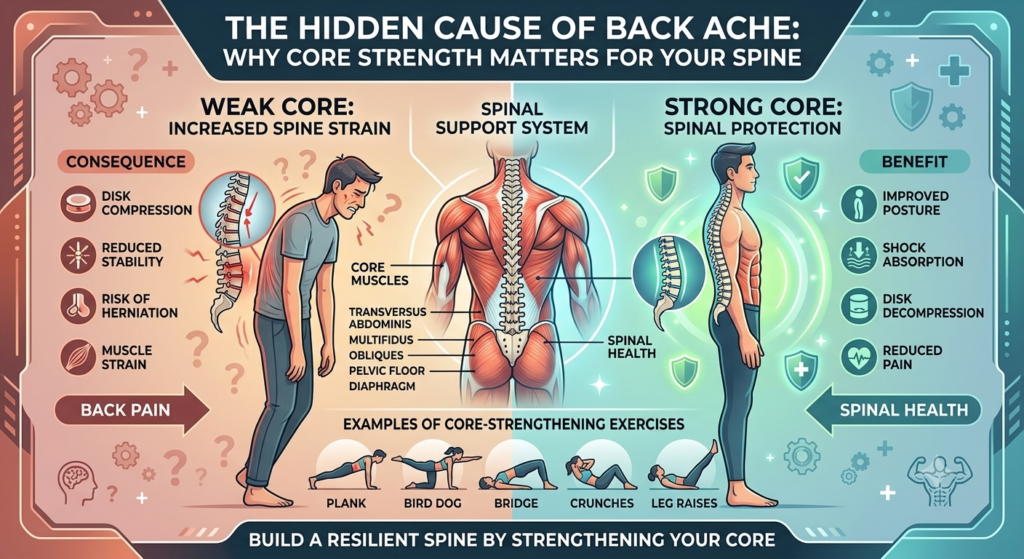
To understand why a weak stomach leads to a sore back, we have to change how we view the “core.” In the fitness world, the core is often associated with a cosmetic “six-pack.” Biologically, however, your core is a complex cylinder of muscles that wraps completely around your midsection, acting as a natural corset for your internal organs and your spine.
-
The Overcompensation Effect: Your lower back (lumbar spine) is incredibly fragile. It is designed to be supported by your deep abdominal muscles (the transverse abdominis). When you spend hours sitting at a desk or slouching on a couch, these front abdominal muscles weaken and essentially “turn off.”
-
Bearing the Load: Because your core is too weak to hold your torso upright, your lower back muscles are forced to compensate. They have to work overtime, carrying the entire weight of your upper body. This constant, daily overcompensation is exactly what causes intense core strength back pain, leading to severe muscle fatigue, tension knots, and compressed spinal discs.
3 Low-Impact Core Exercises to Protect Your Spine
If you already have a sore back, the last thing you should do is start doing aggressive sit-ups or crunches, as these movements forcefully compress the spine. Instead, you need to gently “wake up” your abdominal muscles with these three safe, low-impact movements:
1. The Deadbug
Lie flat on your back with your arms reaching straight up toward the ceiling and your knees bent at a 90-degree angle (like you are sitting in a chair in the air). Press your lower back firmly into the floor so there is no gap. Slowly lower your right arm and your left leg toward the floor, then return to the starting position. Switch sides. This trains your deep core to stabilize your spine while your limbs are moving.
2. The Modified Plank
Planks are the ultimate core builder, but a full plank can strain a weak back. Start on your forearms and your knees (instead of your toes). Keep your back perfectly flat and pull your belly button up toward your spine. Hold this braced position for 20 to 30 seconds.
3. The Bird-Dog
Get on your hands and knees in a tabletop position. Keeping your spine neutral, slowly extend your right arm forward and your left leg straight back. Hold for two seconds, squeezing your core to keep your balance, then return to the starting position and switch sides. This specifically targets the stabilizing muscles wrapped around your lumbar spine.
Soothe Core Strength Back Pain with Ridomaxx
Building a strong, supportive core does not happen overnight. As you begin to incorporate these new exercises into your routine, your abdominal muscles and your lower back will likely experience some temporary soreness as they adapt to the workload.
You need a way to recover quickly without losing your motivation.
The Ridomaxx Solution: When your lower back spasms or your obliques ache from a new core routine, reach for the Ridomaxx Ortho Oil Roll-On. This pocket-sized, mess-free applicator is the perfect post-workout companion.
Formulated with powerful Ayurvedic botanicals, the roll-on allows you to apply targeted relief directly to your lower back and tight obliques without getting greasy oils on your hands or clothes. The fast-acting Gaultheria (Wintergreen) provides a deep, warming sensation that instantly relaxes fatigued back muscles, while the Sesame and Ginger oils increase local blood flow to speed up tissue recovery. It essentially melts away the tension, allowing you to stay active and consistent with your core routine.
Build Your Foundation
Your spine supports you every single day-it is time to give it the support it deserves. By engaging your core with safe, low-impact exercises and keeping a fast-acting Ayurvedic roll-on nearby for muscle recovery, you can conquer core strength back pain and build a resilient, healthy body.